Genetically Modified Organisms (GMOs) are organisms in which the genetic material has been altered in a way that does not occur naturally by mating and/or natural recombination. GMOs can be bacteria, fungi, animals, plants and viruses, with the exception of human beings since there are legal constraints.
All organisms contain genes, which are lengths of deoxyribonucleic acid (DNA) present in every cell. Genes carry the information necessary to produce the numerous proteins that determine the organism’s particular form and function. Therefore, genes are responsible for the specific characteristics of organisms.
In the past, traditional plant breeders have introduced desired characteristics into a plant by crossing different varieties to mix their genes and thereby alter the genetic make-up. This process is called ‘selective breeding’. Nowadays, research and development have led to a better understanding of the science of genes. In fact, scientists have managed to take out a single gene from the DNA of one organism and insert it into the DNA of another organism to confer the desired traits, such as a plant that is resistant to a specific pest or disease. This transfer is also possible between non-related species.
Common GMOs include agricultural crops that have been genetically modified for greater productivity or for resistance to pests or diseases. Examples of modified crops include soybeans, cotton and maize.
‘Biosafety’ is a term used to describe efforts to reduce and eliminate the potential risks from biotechnology products, including GMOs and their production.
For any additional queries, you may check the frequently asked questions (FAQs), contact us via e-mail address on [email protected] or through telephone number 2292 3500.
Other links
What are Alien Species?
Alien Species are any animal, plant, fungi or other organism, which is introduced, either accidentally or deliberately, into a natural environment in which it is not normally found. Alien species are frequently encountered in Malta, with two of the more popular species being the Chameleon (Chamaeleo chamaeleon) and the North African Hedgehog (Atelerix algirus). The affects these species have on their newly introduced environment varies from species to species, however typically they do not cause significant harm to their newly introduced environment. Some alien species, after becoming integrated into the new ecosystem exhibit invasive characteristics.
What are Invasive Alien Species?
Similarly, Invasive Alien Species (IAS) are any animal, plant, fungi or other organism, which is introduced, either accidentally or deliberately, into a natural environment in which it is not normally found. However, unlike Alien Species, IAS are species that typically have serious negative consequences when it comes to their newly introduced habitats and surrounding biodiversity. The extent of their negative impacts are not limited to the environment and ecological resources; they can also have serious negative impacts on human health and even the economy. This is why IAS are classified as one of the 5 major threats and causes of biodiversity loss (UN Environment Programme, 2024).
Locally the Maltese Islands already suffers from the deleterious effects of various IAS. IAS typically have the ability to spread rapidly and grow their population numbers at a faster rate than native flora and fauna, are resistant to various climate stressors and can thrive in multiple habitats, even those not typical to the species. For example, Procambarus clarkii is established within various Maltese freshwater courses. This species out-competes native fauna, changes the freshwater ecosystem and is incredibly resistant to various environmental stresses, including extensive dry periods. Another local example would be Acacia saligna a very commonly encountered established species within various Maltese habitats. Similarly, the species out-competes native flora creating dense populations with extensive root systems, even in soils with low nutrient levels. The species also produces a large quantity of seeds and is resistant to various climate stresses.

Overview and Objectives
Given the growing concern over the threats and impacts that IAS may cause, it has led to the enactment of various relevant policies at a global, European Union and national level. At the European Union level, Regulation No.1143/2014 on the prevention and management of the introduction and spread of invasive alien species (EU IAS Regulations) was put in place to help prevent, mitigate and eradicate IAS. This Regulation aims to create numerous restrictions on the handling, importing, selling, breeding, growing and releasing of IAS into the environment. At the core of this Regulation is the List of Invasive Alien Species of Union concern, a list compromising of species that pose, or that could potentially pose, a great threat to European biodiversity and ecosystems. The species included on the list are subject to the aforementioned restrictions. The list compromises of 88 species, with 47 being animals and 41 being plants and can be found here.

There are currently 9 IAS of Union Concern* present within the Maltese Islands. In no particular order these are:
-
-
- Acacia saligna (ENG: Golden wreath wattle, MLT: l-akaċja);
- Ailanthus altissima (ENG: Tree-of-heaven, MLT: ix-xumakk; ix-xumakk falz);
- Cardiospermum grandiflorum (ENG: Balloon vine; MLT: it-tuffieħ ir-riħ);
- Pennisetum setaceum (ENG: Crimson fountain grass, MLT: il-pjuma; il-penniżetum).
- Pacifastacus leniusculus (ENG: Signal crayfish, MLT: iċ-ċkal tal-ilma ħelu);
- Procambarus clarkii (ENG: Red-swamp crayfish, MLT: iċ-ċkal tal-ilma ħelu);
- Procambarus fallax f. virginalis (ENG: Marbled crayfish, MLT: iċ-ċkal tal-ilma ħelu);
- Gambusia affinis (ENG: Western mosquitofish); and;
- Gambusia holbrooki (ENG: Eastern mosquitofish).
-
Methods of Introduction & Entry
Typically, species have a set range of distribution and will rarely, if ever, set foot outside of this range, this, however, varies from species to species as environmental factors, such as Climate Change, which has had impacts on several species’ natural ranges. They extend beyond their range very often through anthropogenic means. It is often the case that such introduction, in terrestrial environments, is the result of the pet or horticulture trade, where the species is either released into the environment deliberately or is introduced accidentally via an escape. Alternatively, certain species may be introduced to new habitats through various other methods; such as transport contaminants, both of goods and soil or even as hitchhikers through common modes of international transport. With regards to marine non-indigenous species in general, pathways for introduction are primarily transport via hull fouling and ballast waters, followed closely by interconnected waterways. Marine IAS associated with Transport as their main vector include the African blue swimming crab (Portunus segnis). Marine IAS associated with interconnected waterways as their main pathway include the Dusky spinefoot (Siganus luridus). IAS may also be introduced to new habitats via the intentional release of the specimen.
What can you do to help?
If you ever encounter IAS, throughout any Maltese habitat, there are numerous ways that you can help. First and foremost you should familiarise yourself with the list of IAS of Union Concern and the regulations associated with these species to ensure that you are not unintentionally aiding the introduction and spread of the species.
You can also notify the Environment and Resources Authority of both the location of the IAS and extent of its population. Lastly, you can also utilise ERAs Species Observation Survey App, found here, to document the sighting of the species.
For any additional queries, you may check the frequently asked questions (FAQs), contact us via e-mail address on [email protected] or through telephone number 2292 3500.
Other links
- European Commission brochure (2020) – Invasive alien species of Union Concern
- European Commission brochure (2016/2017) – Invasive alien species of Union concern
- ERA automatic update form – Restriction of prohibited species
- ERA IAS leaflet – Stop the spread (2020)
- ERA IAS letter – New restrictions on a number of animals & plants (2020)
- Regulation (EU) No 1143/2014 – Prevention & Management of the Introduction & Spread of Invasive Alien Species
- S.L. 549.119 – Control of Invasive Alien Species of European Union Concern Regulations
- S.L. 549.44 – Flora, Fauna & Natural Habitats Protection Regulations
The term ‘habitat’ refers to the type of area or locality where an organism naturally occurs. The natural habitat of a plant or animal species satisfies its requirements in terms of food, growth, reproduction, shelter and living space.
In the Maltese Islands, there are two main types of habitats:
- Marine
- Terrestrial

Various terrestrial and marine habitats of importance are known from the Maltese Islands, some of which are particularly unique. Amongst these are the magnificent sheer cliffs that border the western side of the Islands. These cliffs, apart from harbouring a variety of endemic species that are only restricted to such habitats, also serve as important breeding sites for a number of seabirds.

When one considers the marine environment, Posidonia seagrass meadows probably represent the most important, natural, marine habitat type in Maltese waters, in terms of productivity. These meadows are a priority habitat of importance at European level, as they provide food and shelter for numerous invertebrates, fish and other marine vertebrate species.
Other links
A striking increase in waste generation caused by rapid economic growth and globalisation over the past decades was accompanied by an increase in global waste trade. Waste has economic value and can provide a useful replacement of natural resources in multiple industries if properly managed. Several countries however are unable to manage all types of waste in an environmentally sound manner due to various limitations hence the need to enable a system for shipments of waste. This is the case of Malta, which insularity and limited resources present a considerable challenge to treat all wastes locally in an environmentally sound and efficient manner.
A comprehensive supervision and control system has first been introduced globally by the Basel Convention on the Control of Transboundary Movements of Hazardous Wastes and their Disposal. This international environmental treaty on waste was adopted on 22 March 1989 in Basel (Switzerland), and was ratified by Malta on 19 June 2000.
The cornerstone of the control regime established under the Convention is the Prior Informed Consent procedure, whereby all countries involved in a planned transboundary movement are duly informed and have to provide their written consent before that movement of waste is allowed to start.
The Convention applies to:
- The hazardous wastes listed in Annexes I and VIII;
- The non-hazardous “Other Wastes” listed in Annex II; and
- Wastes considered to be hazardous under Parties’ national legislation.
The Convention does not apply to the non-hazardous, “green” waste categories listed in Annex IX.
In 1995, the Parties to the Convention agreed to ban any exports of hazardous wastes from those Parties that are members of the EU, OECD, and Liechtenstein to all other Parties to the Convention (Basel Convention Ban Amendment). Malta accepted the Ban Amendment on 12 December 2011.
The provisions of the Basel Convention and the OECD Decision C(2001)107/FINAL on the Control of Transboundary Movements of Wastes Destined for Recovery Operations are implemented in the European Union via Regulation (EC) No 1013/2006 on shipments of waste (i.e. the Waste Shipment Regulation – WSR). This regulation applies to:
- Shipments of wastes taking place within the EU, including such shipments which transit through third parties;
- Imports into the EU from third parties;
- Exports from the EU to third parties; and
- Shipments transiting through the EU.
The WSR establishes different control regimes on shipments of wastes, depending on the origin, destination & route of the shipment, the nature (e.g. hazardous, “green-listed” non-hazardous) as well as the intended fate of the waste shipped (disposal or recovery).
The two main procedures for shipments of waste established under the WSR are:
- Prior notification and consent (Article 4, also known as the TFS procedure in Malta), which generally applies to all wastes destined for disposal and hazardous wastes destined for recovery; and
- General information requirements (Article 18 and Annex VII), which generally applies to shipments of green-listed wastes destined for recovery.
Exports destined for recovery of certain green-listed wastes to certain non-OECD Countries are also subject to Commission Regulation (EC) No 1418/2007.
The WSR also includes a ban on the export for recovery of hazardous wastes and Basel Convention “Other Wastes” to non-OECD countries (Basel Convention Ban Amendment) as well as a ban on any export of waste destined for disposal from the EU.
The WSR is implemented in Malta by S.L. 549.65, the Waste Management (Shipment of Waste) Regulations, which designate the Environment & Resources Authority as the national Competent Authority for the control regime on shipments of waste.
S.L. 549.65 prohibits all imports of waste destined for disposal into Malta.
Regulation (EU) 2024/1157
The new Waste Shipment Regulation (Regulation (EU) 2024/1157) entered into force on 21 May 2024 to modernise and update the EU rules on shipments of waste, and will progressively replace the current WSR.
Waste shipments between EU Member States
While the main procedures for shipments of waste will generally remain the same, the new Regulation will move away from a paper-based approach to an electronic one, while shortening timeframes related to the TFS procedure. As of 21 May 2026, the exchange of information related to shipments will need to be done through a central EU system.
Export of waste to third countries
The general ban on waste exports for disposal to all third countries and a ban on hazardous waste and the Basel Convention non-hazardous “other wastes” exports for recovery to non-OECD countries will continue to apply as per the previous WSR.
New rules on exports for recovery, depending on whether the importing country is an OECD or non-OECD country, will apply as from 21 May 2027 onwards.
- Rules for OECD countries
While the procedural framework for exports to OECD countries outside the EU is very similar to the regime for shipments between Member States, the new regulation empowers the EU Commission to monitor export trends to such countries. If certain exports are increasing and are likely to cause environmental damage in the receiving country, the Commission will engage in dialogue with this country.
Exports will be prohibited if there is insufficient evidence showing that the waste is managed in an environmentally sound manner or that waste imported from the EU is not adversely affecting the treatment of waste generated in that country. Particular scrutiny will be placed on exports of plastic waste.
- Rules for non-OECD countries
In principle, exports of certain non-hazardous wastes are prohibited. Such exports may still be allowed if certain conditions are fulfilled. Non-OECD countries willing to import waste from the EU must notify the EU Commission of their willingness and demonstrate their ability to treat this waste in an environmentally sound manner. A list of countries authorised to import such waste from the EU will be drawn up by the Commission based on the assessment of applications submitted.
The first list of authorised non-OECD countries will be adopted by 21 November 2026 and will be regularly updated.
- Obligations of waste exporters
Companies exporting waste from the EU are to carry out or commission independent audits on the receiving facility. Alternatively, the outcome of audits carried out by other EU exporters or commissioned by the receiving facility may be acquired. The European Commission will maintain a register of audits carried out, which will serve the sole purpose of facilitating the acquisition of audit outcomes from other EU exporters.
- Exports of plastic waste
As of 21 May 2026, exports of green-listed plastic waste (i.e. B3011) to non-EU countries will be subject to the prior notification and consent procedure. Furthermore, as of 21 November 2026, exports of such plastic waste to non-OECD countries will be banned.
However, as of 21 May 2029, non-OECD countries still willing to import “green-listed” plastic waste from the EU may notify the European Commission of their willingness and demonstrate their ability to treat this waste in an environmentally sound manner.

New rules on shipments of electrical and electronic waste
As of 1st January 2025 the new classification and rules for shipments of electrical and electronic waste (also referred to as ‘e-waste’) as agreed to under the Basel Convention will enter into force.
The Annexes of the Basel Convention have been revised to replace the previous entry for hazardous e-waste (A1180) with a new entry for hazardous e-waste (A1181), and to include a new non-hazardous e-waste entry (Y49) that replaces the previous green-listed codes B1110 and B4030. However, the previous green-listed entries will continue to apply only to intra EU shipments of non-hazardous, green-listed e-waste until the end of 2026. As the result of these changes, as from 1st January 2025 the following procedures for shipments from and to the Union and shipments within the EU apply:
- Exports of all e-waste from the EU to non-OECD countries are prohibited;
- Exports of all e-waste from the EU to OECD countries are to be notified;
- Imports of all e-waste from third countries into the EU are to be notified;
- The shipment of e-waste between EU Member States are to be notified, except for shipments of non-hazardous e-waste which can be classified under entries GC010 and GC020, which will remain subject to the general information procedure until the end of 2026. As from 1st January 2027, all shipments of non-hazardous e-waste within the EU shall be notified.
The new classification and rules have been implemented through two EU delegated acts (2024/3229 and 2024/3230) which amend the EU’s Waste Shipments Regulations.
Further links related to Shipments of Waste:
The Waste Regulations, S.L. 549.63, are the overarching national legislation on waste and aim to transpose the provisions of the Waste Framework Directive 2008/98/EC.
The Waste Regulations, S.L. 549.63 provide a framework to protect the environment and human health by preventing or reducing the generation of waste, the adverse impacts of the generation and management of waste and by reducing overall impacts of resource use and improving the efficiency of such use, which are crucial for the transition to a circular economy.
The Waste Regulations set the basic concepts and definitions related to waste management as well as portray the main waste management principles such as:
- The waste hierarchy;
- The polluter pays principle;
- Extended Producer Responsibility (EPR);
- When waste ceases to be waste to become a secondary raw material (end-of-waste criteria);
- How to distinguish between waste and by-products;
- The list of waste;
- Hazardous waste;
- The difference between municipal waste, household waste and biowaste;
- Waste Management Plan.
The waste hierarchy is the cornerstone of European and national waste policies and legislation, ranking waste management options in a specific order according to their environmental impact. Its primary purpose is to minimise adverse environmental effects from waste and to increase and optimise resource efficiency in waste management and policy.

- Waste prevention sits at the top of the waste hierarchy and represents the most environmentally friendly option;
- Preparing for re-use, consists on checking, cleaning or repairing components or products to be re-used without any other pre-processing;
- Recycling is any operation by which waste materials are processed into products, materials or substances for the previous or other purpose. Regeneration of oils or composting of organic waste are considered recycling operations;
- Recovery involves operations that the principal result of which is waste serving to replace other materials which would have been used to fulfil a particular option. Examples of recovery operations are incineration of waste to generate energy or backfilling of inert waste.
- Disposal operations are those which are not recovery for example. Under these category are include a number of operations, such as landfilling of waste, incineration without energy recovery or disposal at sea.
According to the Waste Regulations, any facility carrying out any waste management operations should be permitted by the Environment & Resources Authority, while, as per Regulation 27, waste carriers and brokers should be registered with the Authority.
The Trees and Woodlands Protection Regulations, 2018 (S.L. 549.123) is the principal legal instrument regulating the protection of various tree species and it forms the basis on which these non-exhaustive lists were drawn.
ERA has compiled an indicative list of alien species that should not be planted in such areas due to the fact that their presence results in severe negative consequence for the local environment. This list includes all species of the Second Schedule: Invasive, Alien or Environmentally-Incompatible Species as per S.L. 549.123 and also invasive alien plants of union concern.
The Authority has also compiled a list of trees and shrubs that includes species that can be planted in rural areas around the Maltese Islands. The majority of the tree and shrub species listed are native, archaeophytic or indigenous to the Maltese Islands, as these species help to preserve and enhance the characteristic Maltese’s landscape and also tend to be more beneficial for wildlife. Moreover, some alien trees have been included in this list too, on grounds of their use in fruticulture. It is important to note that these alien species however, do not pose a threat to local biodiversity.
The main aim of both these lists, is to promote environmentally-sound and compatible planting among experts, professionals, voluntary organisations and also the general public.
It should be emphasised that both of these lists are to be treated as non-exhaustive guides and one should remember that they are, by their very nature, subject to changes and updates. The primary focus of these lists, however, is to enhance rural spaces by planting trees and shrubs, which are both suitable and adaptable to the Maltese environment. In addition, both lists provide information on the respective species such as water requirement, whether they are drought and salt tolerant, whether they produce edible fruits, amongst other features. Such notes would help the user to plant the most appropriate species vis-à-vis the rural site of interest.
For any additional queries, you may check the frequently asked questions (FAQs), contact us via e-mail address on [email protected] or through telephone number 2292 3500.
Other links
- European Commission brochure (2020) – Invasive alien species of Union Concern
- European Commission brochure (2016/2017) – Invasive alien species of Union concern
- ERA automatic update form – Restriction of prohibited species
- ERA IAS leaflet – Stop the spread (2020)
- ERA IAS letter – New restrictions on a number of animals & plants (2020)
- Regulation (EU) No 1143/2014 – Prevention & Management of the Introduction & Spread of Invasive Alien Species
- S.L. 549.119 – Control of Invasive Alien Species of European Union Concern Regulations
- S.L. 549.44 – Flora, Fauna & Natural Habitats Protection Regulations
The Trees and Woodlands Protection Regulations (S.L. 549.123) is the principal legal instrument regulating the protection of various tree species and it forms the basis on which these non-exhaustive lists were drawn.
The list of trees and shrubs includes species that can be planted in rural areas around the Maltese Islands. The majority of the tree and shrub species listed are native, archaeophytic or indigenous to the Maltese Islands, as these species help to preserve and enhance the characteristic Maltese’s landscape and also tend to be more beneficial for wildlife. Moreover, some alien trees have been included in this list too, on grounds of their use in fruticulture. It is important to note that these alien species however, do not pose a threat to local biodiversity.
The ERA has also compiled, an indicative list of alien species that should not be planted in such areas due to the fact that their presence results in severe negative consequence for the local environment. This list includes all species of the Second Schedule: Invasive, Alien or Environmentally-Incompatible Species as per S.L. 549.123 and also invasive alien plants of union concern.


The main aim of both these lists, is to promote environmentally-sound and compatible planting among experts, professionals, voluntary organisations and also the general public.
It should be emphasised that both of these lists are to be treated as non-exhaustive guides and one should remember that they are, by their very nature, subject to changes and updates. The primary focus of these lists, however, is to enhance rural spaces by planting trees and shrubs, which are both suitable and adaptable to the Maltese environment. In addition, both lists provide information on the respective species such as water requirement, whether they are drought and salt tolerant, whether they produce edible fruits, amongst other features. Such notes would help the user to plant the most appropriate species vis-à-vis the rural site of interest.
Other links
- ERA IAS leaflet – Stop the spread (2020)
- ERA IAS Letter – New restrictions on a number of animals & plants (2020)
- Regulation (EU) No 1143/2014 – Prevention & management of the introduction & spread of invasive alien species
- S.L. 549.119 – Control of Invasive alien Species of European Union concern regulations
- S.L. 549.44 – Flora, Fauna & Natural Habitats Protection Regulations
- S.L. 549.123 – Trees & Woodlands Protection Regulations
Trees are integral to biodiversity as they provide food and shelter for a variety of organisms, stabilise sediment, assist in soil retention and the uptake of runoff waters. They also contribute various ecosystem services, such as cleaner air, noise abatement and the provision of shade, amongst others.
The Trees and Woodlands Protection Regulations (S.L. 549.123) build on, and ameliorate, the previous Regulations by affording additional protection to trees and woodlands in the Maltese Islands. About 90 different tree species are now protected under the new Regulations, which include an addition of circa 30 new protected species when compared to the circa 60 tree species covered by the 2011 legislation and its earlier 2001 version. These figures clearly show that the new Regulations have further strengthened Malta’s legislative framework on trees.
Moreover, mature trees over 50 years of age that are found in urban, public, open spaces are now protected, irrespective of what species it is, thereby giving due regard to the social and cultural element that trees provide to urban areas.
The Environment and Resources Authority (ERA) will also be able to apply a number of other measures to mitigate adverse impacts on trees by limiting the activity of an intervention, transplanting within or outside the site, and demanding compensatory planting.
Another important change in the new Regulations is the requirement to have licensed tree specialists to carry out interventions on protected trees and on trees located within urban, public, open spaces. These individuals will be required to attend specialised courses, focusing on Maltese trees and woodlands, the identification of species, arboriculture and other related matters, thereby ensuring that pruning and other interventions on trees will be done in a diligent manner. ERA will also establish and publish a Register of Licensed Tree Specialists; such measures are currently not in force to enable the appropriate set-up of a training course and licensing system.
The obligations under the new Regulations are also supported by substantial increases in penalties, which are based on the rarity or protection status of the tree/s. The penalties also distinguish between interventions that result in the destruction/ death of the tree (highest penalty), and other lesser interventions. The Regulations also allow ERA to impose administrative fines for infringements against these Regulations.
Additional provisions on the control of invasive, alien or environmentally incompatible species, such as the blacklisting of additional species of Union concern and the prohibition on the use of such species in urban landscaping, also feature in the proposed Regulations.
The permitting system that is in place for interventions on protected trees has been strengthened through the promotion of best practice on such works. In order to assist the general public and specialists alike, ERA shall be launching guidelines that assist in the interpretation of the obligations emanating from the proposed Regulations, which also contain sections on the practical implementation of interventions on these trees.
The new Regulations give ERA the power to request a bank guarantee to be tied to a permit, issued through these Regulations. A bank guarantee would be forfeited if the conditions implied in the permit are not adhered to, such as when the trees that have been transplanted, or new trees that have been planted in compensation, are not cared for in a manner to ascertain their survival. This will ensure that ERA will be in a position to maintain the trees themselves, should this be required. It is evident that at the core of these decisions, ERA applies sustainability criteria that go beyond the protection of individual trees.
Other links
Legislation
Protected Species
Penalties
ERA webpages
Press release
Presentation
Consultation
BioSnippets
Books on trees
- Protected and Alien Trees in Malta – An Identification Guide
- Common species used for landscaping in the Maltese Islands
Posters
| Poster | Maltese version | English version |
|---|---|---|
| Maltese trees | Link | Link |
| Il-Ballut tal-Wardija | Link | Link |
| Wied il-Miżieb | Link | Link |
| Sandarac gum tree | Link | Link |
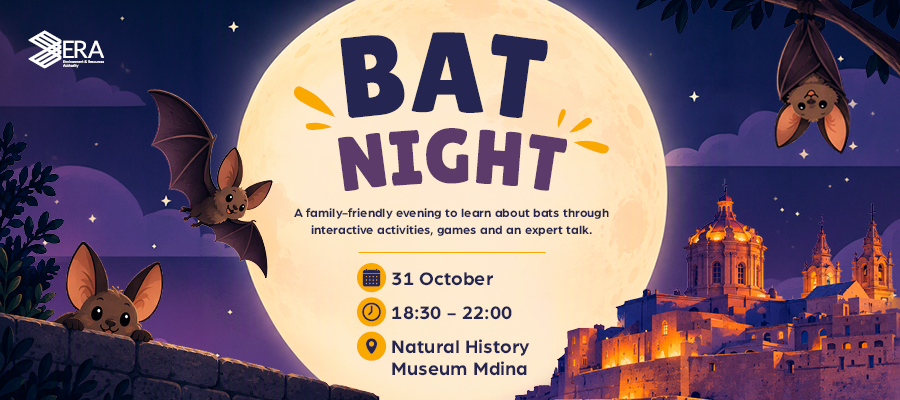
There are 45 species of bats in the European Union. They occur in a wide range of habitats, including forests, garrigues, urban environments and agricultural land.
Although generally widespread, bats are threatened and vulnerable to habitat change and roost disturbance in several EU Member States. In addition, there are still persistent misunderstandings and prejudices arising from ignorance about bats and their habits. As a result of these impacts, many species are threatened; some have even become extinct in a number of countries.
From an ecological perspective, bats are a good ecological indicator as they are sensitive to very slight changes in their environment. Such responses can be useful in revealing habitat fragmentation, ecosystem stress or changing habitat use, resulting, for instance, from the intensification of agriculture or forestry as well as from various other human activities.

This EU Multi-Species Action Plan (MSAP) covers all bat species occurring in the EU. Its aim is to support the development of national or local action plans and implementation of conservation measures. In particular, it aims to:
Provide baseline data on the status of the species in the EU;
- Provide scientifically-based recommendations to promote and support their conservation;
- Establish priorities in bat species conservation;
- Provide a common framework for a wide range of stakeholders.
The MSAP has been prepared and in consultation with EUROBATS and nominated experts from all EU countries following an extensive review of existing literature up until 2015. In the course of the preparation of the document several meetings and consultations with bat experts were held in order to analyse the threats facing the species, develop a conservation strategy and identify the most important actions.
The MSAP provides a summary of the ecology, distribution, status and threats of the bat species in the EU and offers a series of recommended targets and actions for their conservation to guide Member States in the choice of conservation efforts at national, regional or local level.