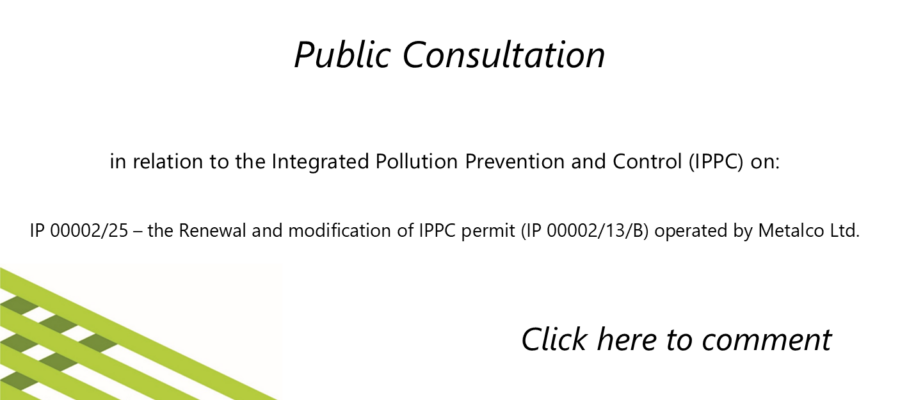
Installations such as the Delimara Power Station are regulated through the Integrated Pollution Prevention and Control (IPPC) permitting process under the Industrial Emissions (Integrated Pollution Prevention and Control) regulations.

This process adopts an integrated approach that takes into account the whole environmental performance of the operations, while requiring that the best available techniques are applied by the industry to minimise pollution. By applying the Industrial Emissions regulations, ERA ensures that emissions such as greenhouse gases, polluting substances, wastewater and waste from these industries are minimised.

In its assessment of this IPPC application, ERA is consulting with other national entities which have various remits related to a specific industry. In its discussions with these entities and the applicant, ERA ensures that all the information required to make a sound evaluation and decision on the permit is requested.

In order to honour its IPPC obligations, and as the national environment regulator in Malta, ERA shall be publishing the IPPC application for a thirty (30) day consultation window to give the public the opportunity to review and comment on the application.

It is pertinent to note that during this period, the authority shall be granting access to the application and related documents at its end to assess the IPPC permit application. This information will be made available on ERA’s website, at ERA’s front office and the local council of the localities in which the installation is proposed. Moreover, a public hearing will be carried out towards the end of the public consultation period.

At the end of the public consultation phase, ERA shall be taking account of submissions received from the public and addressing the issues raised in order to provide clarification to the public. The response to the public consultation shall also be published. Following conclusion of the public consultation, ERA shall continue the process of discussions with the operators in relation to the permit conditions which will form part of the IPPC permit. At the end of this discussion period, ERA Board will take a decision on the IPPC permit at another meeting held in public.

Following the heavy rains of the last two days, the Environment and Resources Authority investigated the turtle nest at Golden Bay to determine whether there were any turtle hatchlings that were trapped in the wet sand and needed assistance to emerge.

It was noted that the vast majority of the eggs, around 85%, had successfully hatched and only a few eggs remained in the nest. These remaining eggs had died in the early stages of development, so would not have hatched.

The Environment and Resources Authority is updating the Air Quality Plan (AQP) together with Transport Malta. The Plan consists of measures, mostly targeting pollution from road transport.

The European Environment Agency state that 70 % of the pollutants and 40 % of the greenhouse gas emissions from European road transport arise due to urban transport. However, they also inform that while human activities are the main cause of poor air quality, natural sources of air pollution also play a role. ERA has determined that the most common natural sources of particulate matter with a diameter of 10 microns (PM10) in Malta are desert dust and salt from sea spray.

The AQP will not be targeting the natural sources of particulate matter, but has been specifically designed with Transport Malta to address ambient concentrations of PM10 (particles) and nitrogen dioxide (NOx) generated by traffic.

For further information one may contact [email protected].

This PR is being issued in relation to recent articles on noise generating activities within Buskett.

ERA would like to inform organisers of activities in Natura 2000 sites, such as il-Buskett, that such activities would require authorisation from ERA before initiating these activities. The ERA is currently setting up a system to handle these activities.

The biodiversity within these areas are afforded varying degrees of protection through national and international legislation. In view of this, a permitting system is in place so as to ensure that activities within these sits do not negatively affect their habitat or species.

The list of Natura 2000 sites and application forms are available on the ERA website  https://era.org.mt/en/Pages/Natura-2000-Datasheets-Maps.aspx and Nature Permitting. Filled in application forms are to be submitted to [email protected] 30 days ahead of any activity. Alternatively, they may be sent by post to Environment Permitting Services, Hexagon House, Spencer Hill, Marsa.​ MRS 1441.

The Environment and Resources Authority (ERA) shall be appealing the PA decision taken in connection with PA 1191/05 (Townsquare High Rise Project). The Board considers that it has sufficient legal and substantive arguments to appeal this case. Further details will be issued following the submission of the appeal.

While ERA has concerns about PA 0581/16 (Mriehel High Rise Project), it believes that an appeal is not the most appropriate tool to address these concerns. ERA shall be taking alternative measures to ensure that such concerns are presented at the right fora, for the best possible outcome.

In the meantime, ERA would like to state that it is not in principle against high rise buildings, as long as these developments take into full account the principles of sustainability. Nonetheless ERA will also be taking other initiatives, including the submission of formal recommendations to Government, to ensure that such high rise developments will be assessed within an improved comprehensive planning and environmental framework.

These decisions were taken today (12th September 2016), at ERA’s Board meeting.

ERA was referred the case of a development to supply electricity to the boathouses in Ġnejna on the 22nd July and has in principle objected to the proposal.

This is because while the trench itself is unlikely to have a significant direct negative impact from an environmental point of view, the fact that provisions of utility services which the proposed trench is intended to serve is ‘illegal development’, is of significant environmental concern.

ERA’s position on this matter is also based on the fact that the area has been designated as a Natura 2000 site (Rdumijiet ta’ Malta: Ir-Ramla taċ-Ċirkewwa sa Il-Ponta ta’ Bengħisa) and is adjacent to the Marine Special Area of Conservation of International Importance (‘Il-Baħar bejn Rdum Majjiesa u Ras ir-Raħeb’).

The Environment and Resources (ERA) has looked into the case concerning the trees that were uprooted from St. Julians.

The Authority confirms that these trees are not protected under environmental legislation, because they are of the invasive alien type, and a threat to the native plant species found in the natural environment. In view of this, the ERA could not request that these same trees be transplanted in the natural environment.

The decision to uproot the trees and not relocate them elsewhere, was taken after the ERA stated the above and following consultation with the Agriculture Department, who confirmed that the trees were too old to be replanted in a contained environment, such as in a garden. Notwithstanding that the trees in question could not be replanted or relocated, it was considered that the residents should not have to bear the loss of trees from the locality and requested that 13 olive trees be planted as compensation. The Olive trees will be planted in Wied Għomor.

The Environment and Resources Authority is currently evaluating how trees which are not ecologically significant, but are of social value, are still afforded protection under environmental legislation in line with the principles of sustainable development. This is so as to ensure that decisions taken to respect this law strike a balance between the social, economic and environmental aspects. The ERA is conducting this task in collaboration with the Ministry for Sustainable Development, Environment and Climate Change and shall be issuing the amended regulations for a public consultation in due course.

The Environment and Resources (ERA) has looked into the case concerning the trees that were uprooted from St. Julians.
The Authority confirms that these trees are not protected under environmental legislation, because they are of the invasive alien type, and a threat to the native plant species found in the natural environment. In view of this, the ERA could not request that these same trees be transplanted in the natural environment.
The decision to uproot the trees and not relocate them elsewhere, was taken after the ERA stated the above and following consultation with the Agriculture Department, who confirmed that the trees were too old to be replanted in a contained environment, such as in a garden. Notwithstanding that the trees in question could not be replanted or relocated, it was considered that the residents should not have to bear the loss of trees from the locality and requested that 13 olive trees be planted as compensation. The Olive trees will be planted in Wied Ghomor.
The Environment and Resources Authority is currently evaluating how trees which are not ecologically significant, but are of social value, are still afforded protection under environmental legislation in line with the principles of sustainable development. This is so as to ensure that decisions taken to respect this law strike a balance between the social, economic and environmental aspects. The ERA is conducting this task in collaboration with the Ministry for Sustainable Development, Environment and Climate Change and shall be issuing the amended regulations for a public consultation in due course.