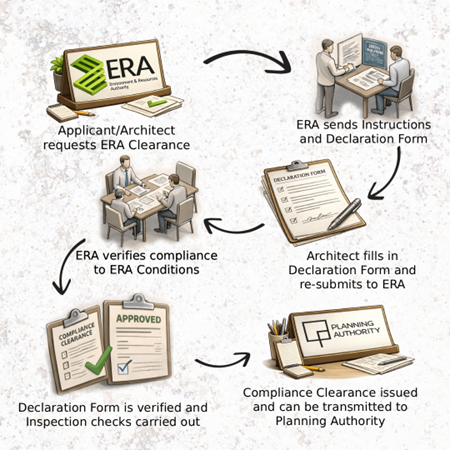
For certain projects requiring a Development Application Permit issued by the Planning Authority (PA), the Environmental Resources Authority (ERA) may be required to establish specific conditions to ensure environmental protection by the applicant, particularly in projects which may have significant impacts to the surrounding environment of the proposed project. The applicant may have to obtain a compliance clearance from the ERA for the Planning Authority to proceed with issuing a Compliance Certificate from the PA. This ERA clearance is issued granted only after the project’s architect, on behalf of the applicant, submits a signed declaration, including a copy of the ERA’s conditions and photographic evidence clearly stating and certifying that these conditions have been satisfied.
The process is as follows:
- The applicant and/or architect requests a Compliance Clearance from ERA, which is required by the Planning Authority (PA) for the Final Compliance Certificate as required by the Decision Notice (DN), to the Compliance and Enforcement Unit (CEU) on: [email protected].
- Procedural instructions are then sent to the applicant and/or architect and a Declaration Form, available from this link, is to be filled in and verify ERA conditions via e-mail giving the applicant and/or architect a 3 month deadline to submit the required declaration.
- The architect on behalf of the applicant must complete this form to confirm that all ERA conditions supported in the PA’s DN have been met, providing the necessary evidence, such as photographic evidence.
- Once the architect, on behalf of the applicant, confirms that all conditions are satisfied and the form is correctly filled out and submitted, the ERA carries out further checks to verify that all ERA conditions are aptly satisfied.
- Inspections may be held as necessary. If during the inspection it is noted that the ERA conditions are not satisfied, further action may be taken by the Authority.
- Once all final checks are finalised and the ERA is satisfied with all documentation and evidence provided, then Compliance Clearance is granted. The architect may then submit this to the Planning Authority accordingly.
Alternatively, the applicants and/or architects may directly access and complete the form, available through this link without the need for ERA to send the form via email, alongside the initial request for compliance clearance. In this case, Steps 3 to 6, above, would then be followed accordingly.
This updated process will minimise administrative steps, facilitate quicker submissions, and improve communication efficiency between the applicant and ERA.
N.B. Kindly note that in the eventuality where ERA notes that conditions are not fully adhered to, the applicant is informed and given a specific timeframe to comply. Failure to meet the conditions may result in enforcement action and/or a refusal notice. If compliance issues persist, ERA evaluates whether the matter can be resolved through an administrative fine or rectification.
* This guideline shall also apply to conditions imposed by the Malta Resources Authority (MRA), with the coming into force of ACT No. XVII of 2024 (amending the Environment Protection Act, Cap. 549) on the 10 May 2024, whereby the Environment and Resources Authority has become the competent authority for subsidiary legislation relating to groundwater and mineral resources.